
What a craft store needs to show first
When someone sells handmade goods, the store has to do the same job as a market table and a catalogue at the same time. Customers want to see the item properly, know what it costs, and understand whether it can be made in a different colour, size or finish. That matters for traders working from Soweto, Alexandra, Tembisa, Durban or Cape Town, where buyers often decide from a phone screen before they ever ask a question.
A craft store usually works best when the front page shows a few strong product categories straight away. Think gifts, home décor, school items, customised pieces, and made-to-order work. A tidy layout helps the customer move quickly from browsing to paying, or to sending a WhatsApp message with a request for a special order.
- Feature the most popular items first, not every item at once
- Use short product names that explain the item clearly
- Show colour choices, sizes and custom options on the product page
- Keep the home page uncluttered so buyers can browse on a small screen
Photos that make hand work look honest
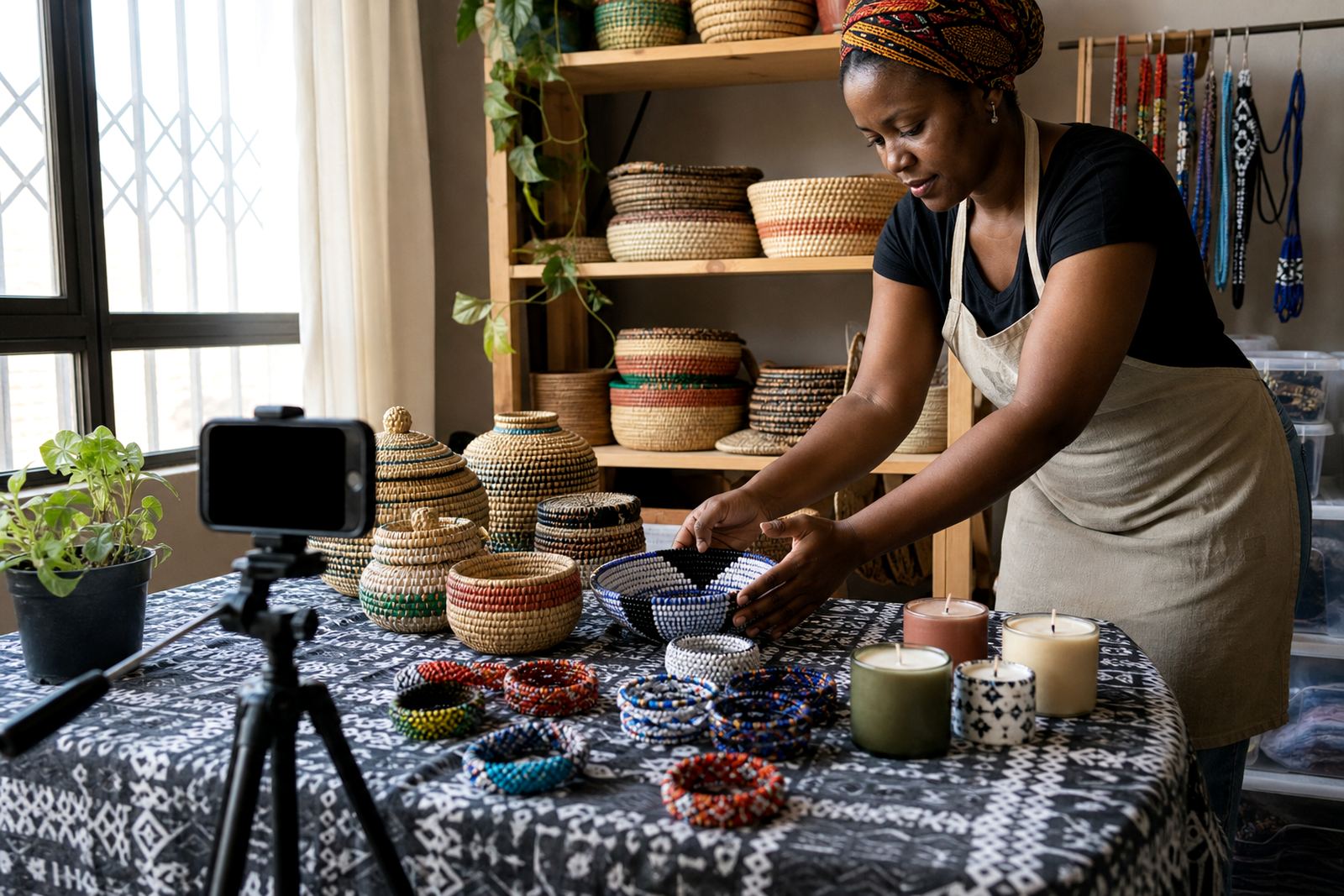
For handmade goods, the photo is not decoration, it is part of the product. A buyer needs to see stitching, weave, paint finish, beads, wood grain or fabric texture. In places like Johannesburg and Pretoria, where many customers compare a few sellers before deciding, poor photos can make a good item look unfinished or overpriced.
Use natural light near a window when possible, and keep the background plain. A tablecloth, a sheet of board, or a neutral wall is often enough. For small items like earrings, candles, coasters or keyrings, take a close shot and a wider shot. For larger items like baskets, cushion covers or wall décor, include a photo that shows scale, because people often struggle to judge size from a single picture.
- Use the same angle for similar items so the catalogue looks ordered
- Show custom work in progress only if it helps buyers understand the craft
- Take one photo that shows the item in use, such as décor on a shelf or a gift set on a table
- Avoid dark rooms and busy backgrounds that hide detail
Pricing pages that stop the back and forth
Craft sellers often lose time when pricing is not clear. A customer may want to know the base price, the cost of an extra name, the surcharge for a rush order, or whether packaging is included. A good pricing page answers those basics without forcing long messages. It also helps with trust, especially when buyers are ordering from another city and cannot inspect the product first.
For handmade goods, it helps to separate ready-made items from custom orders. Ready-made stock can have fixed prices, while custom pieces can show a starting price plus the extras. If delivery changes the final amount, say so plainly. If the seller is in Gqeberha and sending items to Durban or Cape Town, the delivery note should be easy to find before checkout. Customers do not like surprises after they have already chosen their items.
- List the base price next to the product, not hidden in a long paragraph
- Use simple words for extras, such as custom name, colour change or gift wrap
- State whether the price includes packaging
- Keep payment terms and delivery charges visible on the same page where possible
WhatsApp ordering for custom pieces
Many craft buyers prefer to order by WhatsApp, especially for personalised items. They may want to send a name, a colour preference, a reference photo or a message for a gift tag. A store that links to WhatsApp makes that process easier, and it works well for informal traders who handle custom requests from home businesses or market stalls.
The best setup is one where customers can tap from the product page straight into a message with the item name already in place. That cuts down on confusion. It also helps when the trader works with a limited stock of materials and needs to confirm details before making the item. If you sell from Soweto, Durban or Cape Town, WhatsApp can help keep local orders moving without long calls or repeated explanations.
- Use one clear message prompt for all custom items
- Ask for the name, size, colour and quantity in a fixed order
- Keep a separate note for items that need extra drying time or finishing
- Make sure the buyer knows when a made-to-order item will be ready before payment is finalised
Payments, delivery and collection choices
Craft stores usually need more than one way to complete an order. Some buyers want card payment, others prefer electronic transfer, and some want to collect in person from a market, home workshop or pickup point. A clear payment info section helps the customer understand what is accepted and when payment is needed. If the business accepts deposits for custom work, that should be stated plainly.
Delivery options should suit the item type. Small items like earrings, printed mugs, gift boxes or cards are easier to send than large framed décor or fragile pieces. In humid coastal areas such as Durban and Gqeberha, packaging also matters because certain materials need extra care. A delivery page should say whether the buyer can choose courier, local drop-off or collection, and whether fragile items need special packaging. For pricing or tax matters, check with SARS or a qualified adviser if needed.
- Separate delivery for small parcels, fragile items and local collection
- Say whether packaging is included or charged separately
- Keep proof of payment steps easy to follow for buyers who are not used to online shopping
- For custom pieces, state when work starts and when the balance is due
Common mistakes that make craft stores harder to use
A lot of handmade sellers lose sales because the store is crowded, not because the product is weak. Too many categories, unclear prices and poor photos can make a buyer leave before asking a question. Another common problem is mixing ready-made stock with custom orders in the same place without showing the difference. That creates confusion and extra messages from customers who just want to know whether an item is available now.
Another issue is forgetting to explain the size of the item. A candle, basket or wall hanging can look large in a photo and small in real life. That is why measurements matter. Use metres or centimetres clearly, and do not make customers guess. Sellers in Pretoria, Johannesburg and across South Africa often find that a cleaner catalogue brings fewer unnecessary questions and better-quality enquiries.
- Do not hide the price behind a message request
- Do not use too many fonts, colours or background images
- Do not leave out dimensions for items that vary in size
- Do not mix old stock with current stock without updating the page
Budget ranges for a practical first store
Craft sellers do not need a complicated start. A simple store can be built with a small catalogue, a few strong photos and the main buying details in place. For an informal trader or home business, the usual budget depends on how many products need to be uploaded, how much writing is needed, and whether the product pages need a full rebuild or just a tidy refresh. A lean setup is often enough for gifts, décor pieces and custom items that change by season or order type.
As a rough working guide, a basic store with a small number of products can sit in the lower Rand range, while a larger catalogue with photo guidance, pricing pages, WhatsApp order setup and delivery pages will cost more. Product upload help, content writing, and store training may be added separately. For craft sellers in Soweto, Alexandra, Tembisa and other trading areas, it usually makes sense to start with the items that sell most, then grow the store page by page as the business settles.
- Basic store with a few pages and a small product set: often from a lower entry budget
- Mid-range setup with more products, better structure and custom order sections: usually higher
- Full catalogue rebuild, product writing, training and ongoing support: highest range
- Ask for the quote to reflect the actual number of products, photos and pages needed